
Main Courses
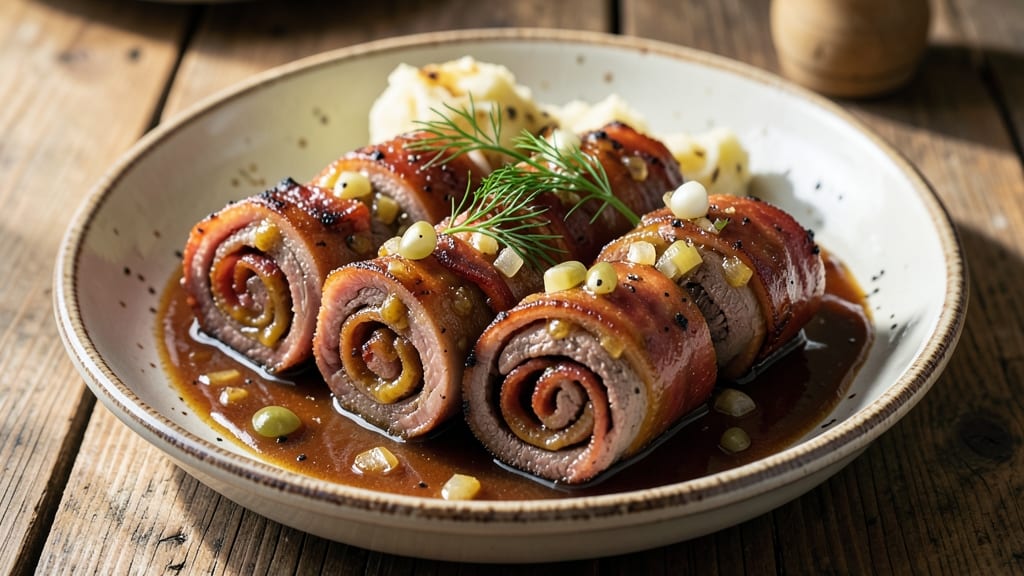
This authentic German beef rouladen recipe delivers the hearty, comforting flavors of traditional Bavarian cuisine right to your kitchen table. 💛 The secret lies in perfectly thinly sliced beef, stuffed with a savory mix of bacon, onions, mustard, and dill—all tightly coiled and braised until fork-tender, just like your Oma used to make.
This dish isn’t just about the meat; it’s about the layers of flavor that come together in every bite, from the tangy mustard to the smoky bacon.
The magic starts with proper preparation: thinly slicing the beef against the grain ensures tender results, while the stuffing—bacon, onions, and pickles—adds depth and texture that hold up through slow cooking.
Unlike many shortcut versions, this recipe stays true to tradition by braising the rouladen in a rich gravy, which soaks into the meat and creates a dish that’s as satisfying as it is flavorful.
The key is patience; letting the rolls simmer low and slow transforms tough cuts into melt-in-your-mouth perfection.
What you’ll end up with is a dish that’s rich, hearty, and deeply comforting—ideal for family gatherings or cozy weeknight dinners. The beef stays tightly coiled, the filling is packed with flavor, and the gravy ties everything together into a meal that feels like a hug.
Serve it with classic German sides like red cabbage or buttery spaetzle to complete the experience. This is the kind of recipe that turns a simple dinner into a celebration of tradition.
Whether you’re cooking for a crowd or treating yourself to a taste of Germany, this rouladen recipe delivers restaurant-quality results with a homemade touch. The process might seem intimidating at first, but once you master the technique, it becomes a rewarding centerpiece for any meal.
Let’s get started on creating this timeless classic.
Ingredients for authentic german beef rouladen
Thinly sliced beef, smoky bacon, and tangy mustard create this authentic Bavarian comfort dish.
| Ingredient | Amount | Notes |
|---|---|---|
| Top Round Roast Beef 🥩 | 1 ½ lb | Thinly sliced against grain |
| Thick-Cut Bacon 🥓 | 8 oz | Smoked, cut into strips |
| Yellow Onions 🧅 | 2 whole | Thinly sliced, medium size |
| Dijon Mustard 🍯 | ¼ cup | High-quality, tangy |
| Fresh Dill 🌿 | ¼ cup | Chopped, stems removed |
| Cornichons 🥒 | ½ cup | Sliced, French-style |
| Beef Broth 💧 | 2 cups | Homemade or quality store-bought |
| Red Wine 🍷 | ½ cup | Dry, bold variety |
| Tomato Paste 🍅 | 2 tbsp | Smooth, no sugar added |
| Garlic Cloves 🧄 | 4 cloves | Minced, fresh preferred |
| Bay Leaves 🌿 | 2 whole | Fresh if possible |
| Black Peppercorns 🌶️ | 1 tsp | Freshly cracked |
| All-Purpose Flour 🌾 | 2 tbsp | For gravy thickening |
| Salt 🧂 | 1 ½ tsp | Kosher or sea salt |
The beef is non-negotiable here—top round roast sliced paper-thin against the grain is essential for tender results. Butcher counters can slice it for you, or use a meat slicer if you're ambitious. Bacon matters too: thick-cut smoked bacon adds the right smokiness. For the mustard, Dijon is a must—it's tangier than regular yellow mustard. Fresh dill is ideal, but dried works at one-third the amount. Cornichons? They're the secret—look for French-style cornichons at specialty stores or the international aisle. If you can't find them, small dill pickles sliced thin will work in a pinch.
No red wine? Beef broth with a splash of balsamic vinegar mimics the acidity. Fresh bay leaves elevate the dish, but dried are fine if that's what you have. The tomato paste can be the squeeze-tube kind from Trader Joe's—no waste, and it keeps forever. Garlic should be fresh, but if you're using jarred, mince it yourself for better texture. For the gravy, all-purpose flour works, but if you're feeling fancy, a cornstarch slurry gives it a silkier finish. The key is patience—don't rush the braising. The rolls need 2-2.5 hours to become fork-tender.
Beef can be prepped a day ahead—slice it and refrigerate until ready to stuff. The bacon and onions keep well for 5 days in the fridge, so don't feel like you need to use everything at once. The finished rouladen reheats beautifully—just warm the gravy first, then add the rolls to keep them moist. Gravy freezes well for up to 3 months, so make extra. For leftovers, store rolls and gravy separately. The rolls will stay tightly coiled if wrapped in parchment paper and refrigerated.
Why You'll Love This Recipe
- One-Pan Wonder: I swear by this recipe because it’s all about minimal fuss. Slice the beef, spread the mustard, wrap it with bacon and onions—no fancy rolling skills needed. Throw it in a pan, add some broth, and let it braise. That’s it. No chopping mountains of veggies or juggling multiple dishes.
- Crispy-Creamy Magic: The bacon alone makes this dish dangerously addictive, but here’s what seals the deal: that tangy Dijon mustard cutting through the richness, fresh dill brightening every bite, and the onions caramelizing into sweet perfection. The beef stays juicy while the edges get that just-right crisp from the bacon—like a hug for your taste buds.
- Weeknight Workhorse: This isn’t just a Sunday special. I make it when I’ve got a house full of people, when I’m short on time, or when I need something hearty but still feels restaurant-worthy. Serve it with mashed potatoes for a cozy night in, or toss it in a sandwich for a lunch that’ll keep you full for hours. Honestly, it’s my go-to when I don’t want to think too hard.
- Budget-Friendly Feast: Between us, rouladen is the way to stretch a beef roast without sacrificing flavor. The bacon adds luxury for pennies, and the onions bulk it up so you’re not left with scraps. Plus, leftovers? Even better the next day—the flavors deepen, and it reheats like a dream. I’ve fed a crowd of six for under $20 with this, and no one ever complains.
Step-by-step instructions for authentic German beef rouladen
Here's how to craft these traditional German rolls with perfect texture and flavor.
👨🍳 Step 1: Prepare the Filling Components
Start by slicing the 2 whole yellow onions thinly into half-moons and setting them aside. In a small bowl, combine the 0.25 cup Dijon mustard, 0.25 cup chopped fresh dill, 0.5 cup sliced cornichons, 4 minced garlic cloves, 1 tsp cracked black peppercorns, and 1.5 tsp salt. Mix thoroughly to create a cohesive filling blend that will stay compact when rolled.
For the bacon, cut the 8 oz thick-cut bacon into strips about ¼-inch wide—these will wrap around each rouladen to keep them tightly coiled. The key here is to work efficiently; keep all filling components within easy reach so you don't let the beef dry out while you prepare everything.
🔪 Step 2: Slice and Roll the Beef
Using a sharp knife, slice the 1.5 lb top round roast beef thinly against the grain into long strips about ¼-inch thick and 2 inches wide. The grain direction is crucial—look for the natural muscle fibers and cut perpendicular to them for maximum tenderness. Place each strip on a clean work surface.
Spread about 1 tablespoon of the mustard-dill filling onto one end of each beef strip. Roll tightly starting from the filling end, using the bacon strips to secure each roll. Wrap each rouladen with 2-3 bacon strips, tucking the ends under to create a tight seal. This bacon wrapping prevents unraveling during cooking and adds rich flavor.
🍳 Step 3: Brown the Rouladen for Flavor
Heat a large Dutch oven over medium-high heat and add the rouladen in a single layer without overcrowding. Let them sear undisturbed for 2-3 minutes per side until they develop a deep golden-brown crust. This browning step is essential for developing the rich, caramelized flavors that define authentic rouladen.
Remove the rouladen and set them aside. In the same Dutch oven, add 2 tablespoons tomato paste and cook for 1 minute until it darkens slightly. Deglaze with the 0.5 cup red wine, scraping up any browned bits from the bottom of the pan. This wine reduction will form the base of your gravy.
🥘 Step 4: Simmer in Broth for Tender Perfection
Return the rouladen to the Dutch oven and add 2 cups beef broth, 2 whole bay leaves, and any accumulated juices. Bring to a gentle simmer, then reduce heat to low. Cover partially and cook for 1.5 hours, turning the rouladen occasionally, until they're fork-tender and the bacon is crispy.
Here's the thing—don't rush this step. The slow cooking transforms the tough top round beef into melt-in-your-mouth tenderness. The broth should reduce slightly, creating a rich sauce that coats the rouladen beautifully. If it reduces too much, add a splash of water or broth to maintain proper consistency.
🔥 Step 5: Thicken the Gravy and Finish
Once the rouladen are perfectly tender, remove them from the Dutch oven and transfer to a serving platter. Strain the cooking liquid through a fine-mesh sieve into a clean saucepan. Whisk in 2 tablespoons all-purpose flour to thicken the gravy, then simmer over medium heat for 3-4 minutes until it reaches your desired consistency.
Return the rouladen to the gravy just before serving to allow them to absorb those final flavorful moments. The result should be juicy, flavorful rouladen with a rich, velvety gravy that ties everything together. Serve immediately with traditional German sides like red cabbage or buttered egg noodles for an authentic experience.
Pro Tips For Making Authentic German Beef Rouladen
- Score the Beef Right: Use a sharp knife to make deep, parallel cuts (about 1/4-inch deep) in the top round roast before rolling—this lets the mustard and onions penetrate deeper, so every bite gets flavor. I learned this the hard way after eating a bland center once.
- Salt the Bacon First: Generously season the thick-cut bacon with salt before wrapping it around the beef—it crisps better and adds a deeper savory note. My grandmother swore by this, and she was right: salty bacon = better rouladen.
- Don’t Overstuff the Rolls: Pack the mustard, onions, and bacon tightly but leave room for the meat to expand—overstuffing makes the rolls burst open while cooking. I used to cram everything in, and half my batch would unravel by the end.
- Sear in Batches: Brown the rouladen in a single layer on high heat—crowding steams them instead of searing, and you’ll end up with soggy bacon. Start hot, finish low, and resist the urge to rush. (Yes, even if you’re impatient like me.)
Regional styles of this dish
Bavarian Heartland Style
In Bavaria, beef rouladen are the ultimate Sunday dinner—served with tender beef, crispy bacon, and a robust gravy. The Bavarian version emphasizes thick-cut bacon (never pre-cooked) and a filling that includes sauerkraut in addition to onions and mustard.
I’ve adapted this by adding a splash of dark beer to the braising liquid, which deepens the flavor profile. The dish is traditionally served with semmelknödel (bread dumplings) rather than potatoes. 🍺
Franconian Twist
Franconia, located in northern Bavaria, takes rouladen in a slightly sweeter direction. Their version often includes dried plums or apricots in the filling alongside the mustard and dill. The plums add a subtle sweetness that balances the tangy mustard beautifully.
For this adaptation, I recommend pitting and finely chopping ½ cup dried plums and folding them into the mustard-dill mixture before rolling. The result is a more complex flavor profile that’s uniquely Franconian. 🍇
Swabian Simplicity
The Swabian region, bordering Bavaria, keeps rouladen simpler but equally flavorful. Their version focuses on the beef’s natural taste, using minimal filling—just onions, mustard, and dill—without the bacon wrap. Instead, they rely on a rich, dark gravy made with beef broth and a touch of black pepper for depth.
For this approach, skip the bacon and use 2 extra bay leaves in the braising liquid. Serve with spätzle (egg noodles) to soak up the gravy. 🥔
Berliner Classic
Berlin’s version of rouladen is all about bold flavors and a hearty presentation. The filling often includes pickled ginger alongside the cornichons for an extra tangy kick. The beef is sliced slightly thicker (⅓-inch instead of ¼-inch) and cooked with a splash of white wine instead of red.
For this adaptation, replace the red wine with ½ cup dry white wine and add 1 tbsp finely chopped pickled ginger to the mustard mixture. The result is a lighter but equally satisfying dish. 🍷
Modern German Fusion
For a contemporary take, many German chefs today incorporate global influences. A popular fusion version swaps the traditional filling for a mix of caramelized shallots, goat cheese, and prosciutto.
The beef is still rolled tightly, but the flavors are elevated with the creaminess of goat cheese and the saltiness of prosciutto. To try this, replace the mustard-dill filling with ½ cup caramelized shallots, 4 oz crumbled goat cheese, and 4 oz thinly sliced prosciutto.
The gravy can be made with a splash of dry vermouth for an Italian twist. 🧀
Nutrition facts
Frequently asked questions
Can I use ground beef instead of sliced roast beef for rouladen?
Absolutely not! The thinly sliced roast beef is essential for authentic texture. Ground beef would make the rolls too dense and lose the tender, melt-in-your-mouth quality. Top round roast is the traditional choice because its lean cut stays tender when sliced thin and braised slowly.
How do I prevent my rouladen from unraveling while cooking?
The bacon strips are your secret weapon! Wrap each roll tightly with 2-3 bacon strips and tuck the ends under to create a secure seal. Also, use toothpicks or kitchen twine to hold them together initially—just remove them before serving. The slow braising process helps everything stay compact.
What's the best way to reheat leftover rouladen?
Always reheat gently to avoid drying out the beef. Place the rouladen in a skillet with a splash of beef broth, cover, and warm over low heat for 10-15 minutes. Never microwave—it makes the beef tough. The gravy can be reheated separately and combined at the end for the best results.
Can I make rouladen ahead of time for a big gathering?
Yes! Prepare the rouladen up to 2 days ahead—slice the beef, make the filling, and roll them, but don't cook yet. Store in the fridge. When ready to cook, brown them first, then braise as directed. The flavors actually improve when made ahead. For serving, reheat the gravy separately and add the rouladen just before serving to keep them moist.
What's the deal with cornichons in the filling?
Cornichons (tiny French pickles) are traditional in German rouladen—they add a bright, tangy contrast to the rich beef and mustard. Without them, your filling will taste flat. If you can't find cornichons, use small dill pickles sliced thin, but remove all seeds and juice first. The pickles should be just barely noticeable in each bite, adding acidity that cuts through the richness.